Showing posts with label Church. Show all posts

Sunday, 29 April 2012

The Churches of Northland: St Mary's Church at Motuti

St Mary's Church at Motuti which dates from 1899 attracts local and international pilgrims to the shrine of the country's first Catholic bishop.


Bishop Pompallier was born in Lyons, France, in 1802 and ordained a priest in 1829. In 1836 he was consecrated a bishop in Rome and appointed Vicar Apostolic of Western Oceania - a vast expanse of the Pacific ocean, amounting to about one-sixth of the globe.

On January 10, 1838, the bishop and two assistants, a Marist priest and a Marist brother, sailed up the Hokianga harbour on New Zealand's west coast. They were welcomed by an Irish-born (but French-educated) timber merchant, Thomas Poynton, and his Australian-born wife.

In the Poynton's home at Totara Point the bishop celebrated the first Catholic Mass in New Zealand on January 13, 1838.

Bishop Jean Baptiste Francois Pompallier ministered to indigenous Maori and European settlers from 1838 until 1868. He then returned in ill health to his native France where he died in 1871.

In 2001, at the request of Maori Catholics, the bishop's remains were exhumed from his grave at Puteaux, on the outskirts of Paris, and, following a requiem Mass in Notre Dame Cathedral, returned to New Zealand.

During a 16-week sacred journey throughout New Zealand in 2002, crowds gathered to pay their respects to the bishop in each of the six Catholic dioceses. Then, before a large gathering - including Catholic bishops from New Zealand, France and the Pacific Islands, and the French ambassador to New Zealand - the remains were reinterred beneath the altar of St Mary's Church.


Friday, 20 April 2012

The Ferry to Rawene

When we went to the Church at Motukaraka, in order to avoid a very long road journey, we first had to get the ferry across the Hokianga Harbour from Kohukohu where we were staying to Rawene (a lovely little place with an exceptionally helpful garage - well it was the owner rather than the garage who was helpful.  Odd how we sometimes say that a thing is helpful).  Before we got on the ferry we could see the church across the harbour in the far distance.  The buildings below the church is the Marae of the hapu on who's land the church stands.


Wednesday, 18 April 2012

The Churches of Northland: Motukaraka

It's now well over a month since Pauline and I set off for a long weekend exploring the churches around the Hokianga Harbour on the West side of Northland.  I've already posted about the Church at Pakaraka.  Now for the second one.  The Church of Our Lady of the Assumption at Motukaraka.

Opened on 3 April 1910, with festivities attracting more than 2000 people, the church was entirely funded by the local Maori community after taking nearly 3 years to build.  It is constructed of kauri much of which came from the hapu lands at Tapuwae where kauri stands had survived the extensive logging in the region.

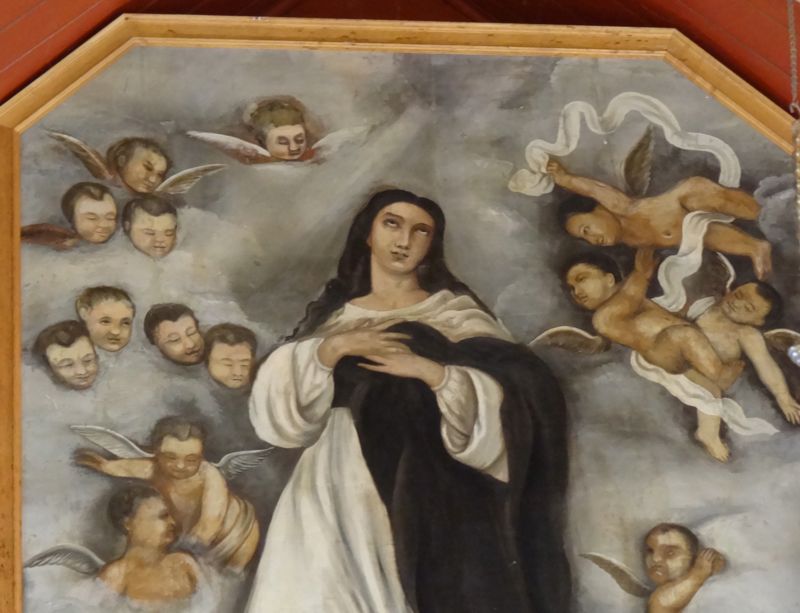
The painting over the alter is a copy of the Assumption of Our Lady by the Spanish painter Murillo which had previously hung in the Native School having been brought out to New Zealand by a Motukaraka schoolmaster.

The church is on land owned by local Maori, The Ngai Tupoto ki Motukaraka, (the Ngai Tupoto hapu is part of the iwi of Te Rarawa) who have maintained the church since it was built.


Monday, 27 February 2012

Churches of The Hokianga: Pakaraka

The Church of The Holy Trinity in Pakaraka was the first church we called at on the way from the Airport at Whangerei to Kohukohu.  This church was endowed by Archdeacon Henry Williams who was a missionary to the Maori people for 44 years.  the church was erected by his sons and opened for worship on 23 April 1851.  I think that, despite being in better condition than most of the churches we saw, it was at 160 years, also the oldest.  I'll correct that if need be as I check other churches.


The wall hanging depicts the Holy Trinity and is made of flax from kneelers used in the church and made circa 1916.


The harmonium is undated but many of the churches had a harmonium.  I was particularly interested because Mum had a harmonium which she played occasionally - we had very tolerant neighbours.


Sunday, 26 February 2012

Churches of The Hokianga

For three days Pauline and I have been on a pilgrimage to see and photograph the churches of the Hotianga in New Zealand's Northland.   I suspect that some may think it odd that an atheist (that's me, I'm not sure what Pauline is) is running around with an interest in churches.  It's quite simple.  As one of the people we met, a Maori by the name of Mr Pickering, said when we asked whether there was a good congregation at the church "The old are dying off so they don't come any more.  The young don't come to church.  The rest ?.  So the churches are empty."  But they come to be buried.  For me what is important is the role that the church played as a focal point in society and the conversion and education in European language and ways of the indigenous population of New Zealand.  In addition there are so many attractive old (by New Zealand standards) church buildings occupying the most significant places in the landscape and in the culture and history of the country that I feel their preservation is both culturally and historically important.

I could post on a lot of old churches which I'm sure would bore you very much.  Notwithstanding the latter statement I shall probably put many of them on the blog over the next while just so that I have a record of them.

The area we covered for the exploration is shown on this map.  We were staying in Kohukohu.


Saturday, 22 January 2011

The Church at Otane

The Church of St James The Apostle was consecrated an Anglican Church on 21st January 1894.   Although I can find no references to dates on the internet the last Vicar of Otane ceased to hold that office in 1982.  The church is now an inter-denominational church (which seems quite common in rural New Zealand).  The church is attractive and appears to be well looked after and the  attractive but unremarkable stained glass window's provenance is recounted inside.  However what struck me was the window at the opposite end of the church which I thought was one of the most beautiful windows I have ever seen in a church.


Unfortunately it was difficult to photograph and describing it is even more difficult.  By using the tress outside for contrast the content of the window appears.  The pattern is shown by raised material which appears to have been applied to the glass in the way one would apply something like building sealant!  The opaque areas may have been acid etched.  I shall have to do some homework on this one.  In the meantime I thought I'd share it with you.  If anyone does know the process used I should be glad to hear.

Saturday, 20 March 2010

Cathedral Lectern

One of the items at Waiapu Cathedral of St John the Evangelist that I did not show you was the lectern given in memory of the first Dean.  It was the only piece of the furnishing of the Cathedral to survive the Earthquake.  It will probably survive long after the present Cathedral has fallen into ruins.  After all, a thousand years is a small amount of time for such an article.

DSC07248

DSC07249

DSC07250

Thursday, 11 March 2010

Waiapu Cathedral, Napier

Yesterday morning I visited the Anglican Cathedral in Napier.  I had not done so before.  In fact, apart from attending a funeral I cannot recall being in any church in the City before today.  Mind you most churches are locked against vandals these days.  Although I didn’t visit it for the purpose of blogging nor, indeed, to take photos I ended up being treated as a tourist and decided to become one.

The present building was started in 1955 to replace a temporary wooden building which was erected in 1932 after the 1886 Cathedral was destroyed by the earthquake whilst communion was being served on 3rd February 1931.  That had been the second church on the site.

DSC07271 DSC07264 DSC07251 DSC07270 DSC07255 DSC07260 DSC07242

There is more of interest in the Cathedral but I will reserve these for occasional postings in the future.

Saturday, 20 February 2010

The Great Adventure: Day Four: Russell - Christ Church - Part Two

Yesterday I posted some photos of Christ Church and today I shall finish that by posting about a few of the graves.  But before that I shall answer a question by Rae and Pauline arising from yesterday's post.  It related to the tapestry cushions.   In 1990 a project to fit the pews with tapestry-covered cushions was established.  These cushions last until the next century.  Local artists and others have designed the cushions so that the historic scenes of Russell, local Maori history, local activities, ships of missionaries and explorers, native birds and flowers, old houses, whales and dolphins are depicted.  Sixty three embroiderers have made the cushions.  Most are from the Russell area but others are from all over New Zealand and overseas - some with former ties to Russell such as relatives of the builder, carpenter and catechist, some with holiday homes in the area, some who lived in Russell for a time and sailors who just called in on their passages.  The project was completed in 1992 when cushions for the chairs in the church were started.

Like all old churches the grave yard was educational.  


This is the first undressed gravestone I can recall


Hannah King Letheridge (now known to be the second European girl to be born in NZ),


The interest in this lies partly in its size and partly in its juxtaposition to the previous grave 


 The two graves side by side


On 11 March 1845, during the Battle of Kororareka between British forces and Maori dissatisfied with British rule, the church was hit by stray musket and cannon balls, evidence of which is still visible today but, as Pauline pointed out, we failed to photograph it.  Duh!  This is the grave of the men from HMS Hazard who fell in the battle,


The grave of Tamati Waka Nene, the Ngapuhi chief largely responsible for the Maori’s acceptance of the Treaty of Waitangi and who fought for the settlers against Hone Heke.

Friday, 19 February 2010

The Great Adventure: Day Four: Russell - Christ Church

One of the most fascinating churches I have encountered - and there are many in New Zealand - is Christ Church in Russell.  The church is the oldest church still used as such in NZ today, and possibly the oldest building still used for its original purpose.  Its history is fascinating.


Another example of a tiny place 'donating' its souls to the defence of a far away land - although there could, of cours, have been repercussions for New Zealand, particularly in the Second World War from Japan


The whole church has individually worked seat cushions.  Interestingly when I regularly worshipped in churches in communion with the Church of England or the Roman Catholic church members of the congregation sat on hard pews and kneeled for prayer and these would have been kneelers.